
Phronesis, the art of aligning your life with your soul

I'm just like you. I'm looking to live with greater accuracy, clarity and inner coherence. And recently, when I came across an article evoking the Greek notion of Phronesis, something awakened in me. The word intrigued me. I had a vague idea of it, but as I delved deeper, I discovered a wisdom that resonates deeply with what I'm living, what I'm trying to convey, and what you may be feeling too.
So much so, that it inspired me to write this article. To share this discovery with you, and explore together how this forgotten wisdom can nourish our inner lives and our simplest gestures.
How can we live a life aligned with our soul?
How can we make the right choices, at the right time, in harmony with ourselves and the world?
If you're asking yourself these questions, you've come to the right place.
In our fast-paced society, where wisdom is often confused with the accumulation of knowledge, we've forgotten that true wisdom is simple, discreet, almost invisible. It slips into our most everyday gestures: a sincere look, a calm decision, a present silence.
What if wisdom wasn't in books, but in the way you prepare a meal? How you gently say no? To really listen?
Ancient Greek philosophy offers us a precious word for this practical, embodied form of wisdom: Phronesis.
In this article, we'll discover together how this forgotten virtue can transform your daily life, help you find your center, and make your life a sacred form in motion.
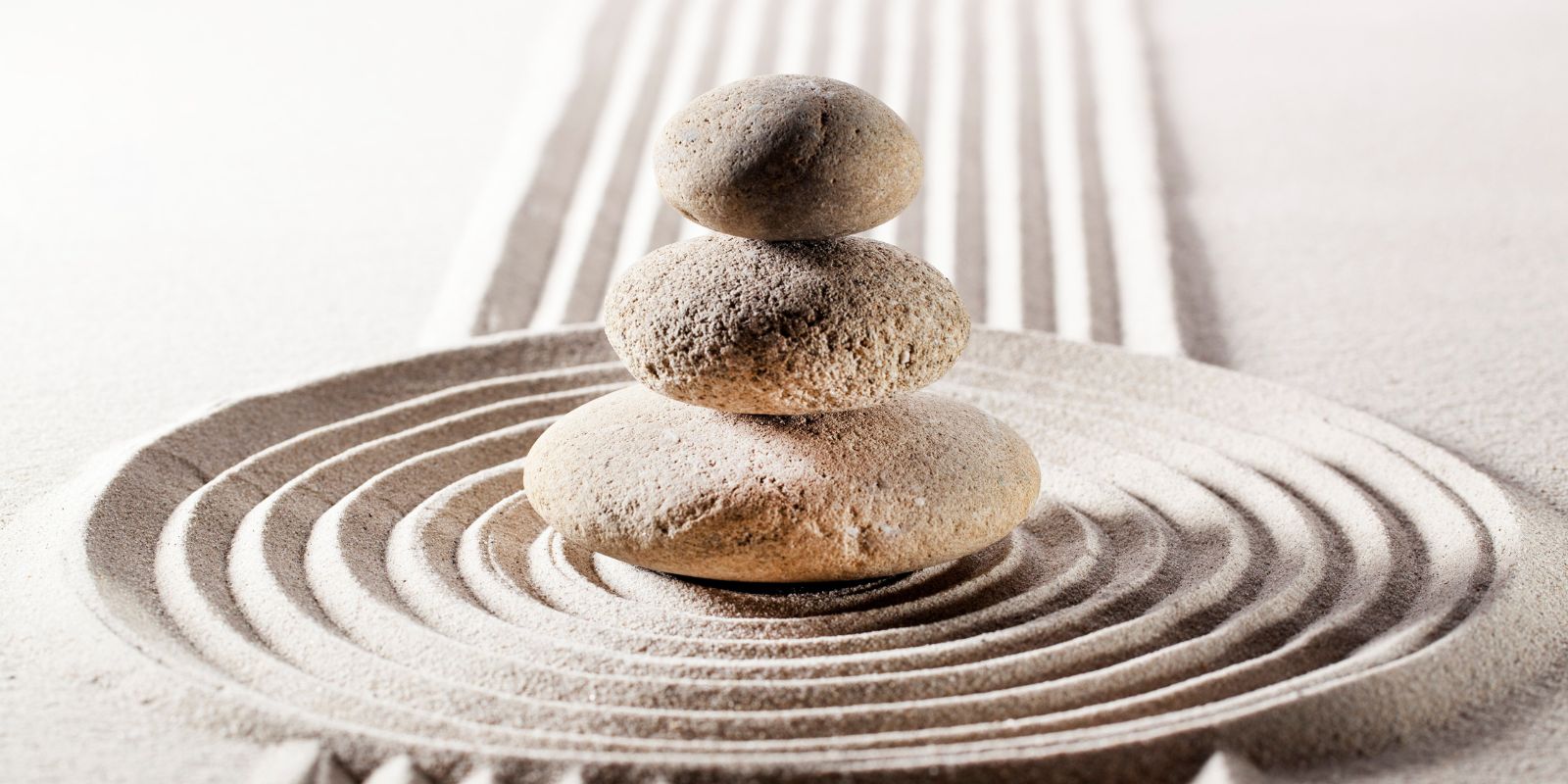
What is phronesis? Definition
The word "Phronesis" comes from ancient Greek and literally means "practical thinking" or "common sense". But its scope goes far beyond that. In classical Greek philosophy, notably Aristotle's, Phronesis is an intellectual virtue essential to a good life: it is the ability to discern the right action in concrete situations, to find the balance between excess and defect. It is neither universal nor rigid: it adapts to each context.
In Plato, although the term is less central than in Aristotle, the idea of practical wisdom also exists. In "Phaedo" or "The Republic", Plato insists on theharmony of the soul: when reason guides desires and emotions, the human being lives in peace. Phronesis could then be seen as the concrete expression of this harmony in action.
So, whether we follow Aristotle or Plato, Phronesis invites us to live in an intelligence of reality, a coherence between our inner self and the external world.
Phronesis: Aristotle's embodiment of practical wisdom
For Aristotle, Phronesis is not theoretical knowledge. It's a virtue of discernment, an ability to make the right decisions in concrete situations. It is the wisdom of the parent who understands the right moment to set a limit, of the craftsman who knows the resistance of the material, of the caregiver who knows when to speak and when to remain silent.
It is neither pure intuition nor cold logic. It is the subtle balance between heart, reason and experience. A form of deep listening to reality.
Phronesis manifests itself in the present moment, in that quality of attention that enables us to sense what is appropriate, what uplifts, what respects the living order. It also implies the moral courage to act consciously, even when this is uncomfortable.
Aristotle insists that this virtue cannot be taught like a science: it is developed through experience, through self-observation, through direct contact with life. It's an experiential wisdom, forged over time, in relationships, in trials, in commitments.
To live according to Phronesis is to choose the right adjustment rather than automatic reaction, to embody a form of awakened presence at the heart of matter.
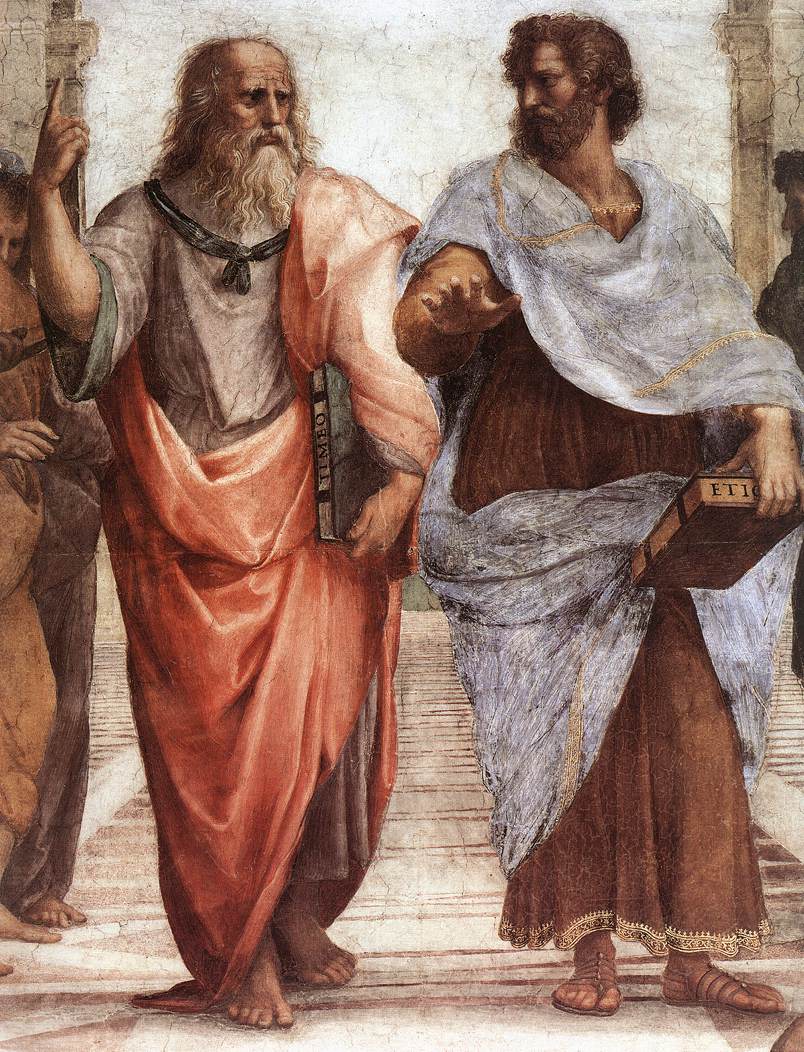
Right: detail of The School of Athens, a Vatican fresco by Raphael (early 16th century). Plato (left) points to the sky, symbolizing his belief in the Ideas. Aristotle (right) turns his palm towards the ground, symbolizing his belief in empirical observation.
Living wisdom from Peter Deunov and Omraam Mikhaël Aïvanhov
What the Greeks called Phronesis, Peter Deunov and Omraam Mikhaël Aïvanhov have transmitted in the form of an active, vibrant wisdom, present at every moment of life. For them, true spirituality is never separated from concrete, everyday life. It is embodied in our gestures, our words, our attitudes.
Omraam Mikhaël Aïvanhov said:
"True spirituality begins in the details: the way you eat, speak, look at others."
He reminded us that every moment of the day is an opportunity for elevation, that the spiritual being is not one who escapes the world, but one who shines in it. Phronesis, in this perspective, becomes the light of the soul translated into action, the concrete manifestation of an awakening inner presence.
Peter Deunov, for his part, insisted on the importance of unity between thought, feeling and will. This triad, when harmonized, produces right, meaningful action. He taught that the truly spiritual man is one who acts with love, wisdom and truth, in the smallest gestures of life.
From this point of view, living according to Phronesis means making every moment a sacred act, a silent prayer, a discreet service to life. It's not an outward morality, but a deep inner alignment, a fine tuning of the right moment. A living, humble and radiant wisdom.
To live according to Phronesis is to be a conscious channel for the wisdom of the soul, in our daily choices, attitudes and relationships. It means embodying spirituality, not in theory, but in action.

Why phronesis is indispensable today
We live in an age where information circulates faster than our ability to discern it. Social networks, opinion channels, artificial intelligences that generate images, texts and emotions: all this forms an uninterrupted flow of stimuli that constantly solicit our attention, our judgment and our reactivity.
We are asked to take a stand on everything, all the time. To react, to take sides, to have an immediate opinion. And yet, by dint of wanting to comment on everything, understand everything, judge everything, we risk losing what is most precious to us: our center.
Phronesis, now more than ever, is an indispensable compass. It reminds us that the most important thing is not to be right, but to do the right thing. It invites us to withdraw from the tumult to listen to our own truth, to rediscover our inner sovereignty instead of seeking external approval. It enables us not to be swept away by the currents of illusions and manipulations, but to remain in our radius, in our axis, in our peace.
In this sense, it is a form of luminous resistance to collective agitation. A silent but powerful wisdom.
What sacred forms teach us
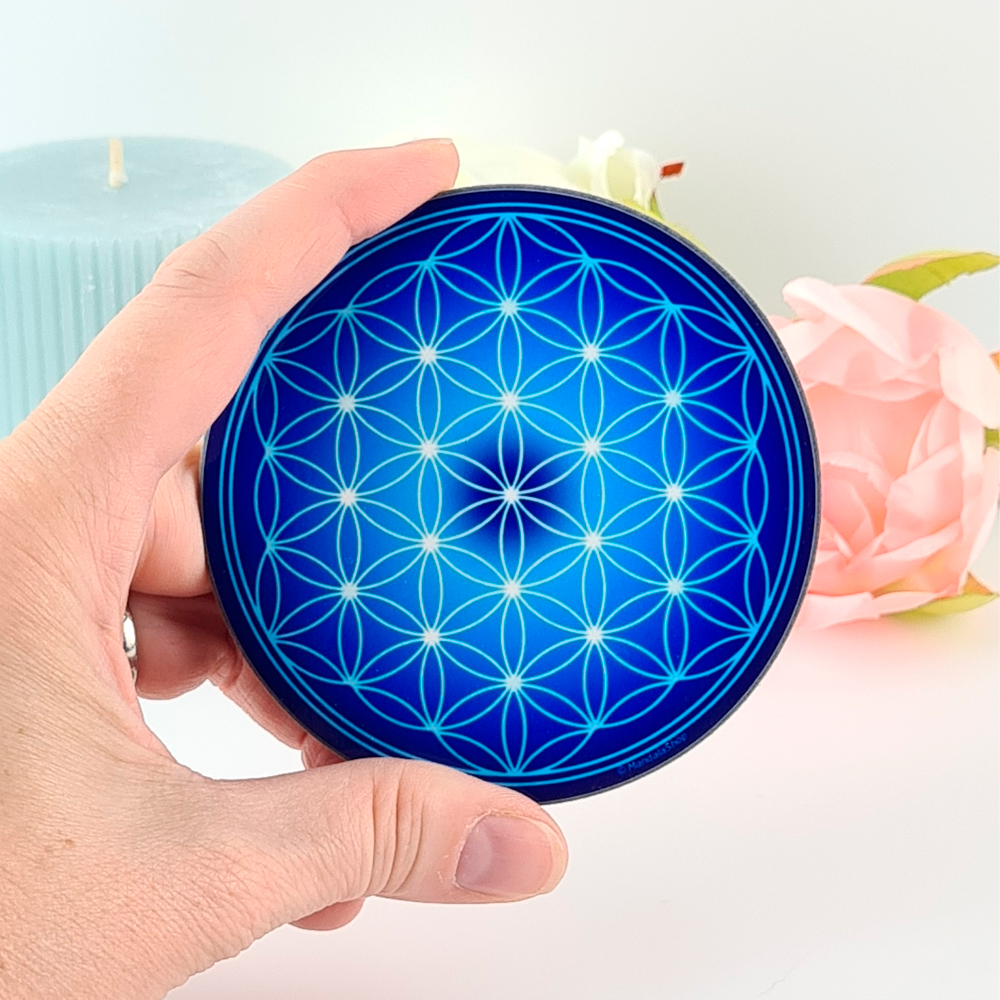
When we contemplate a Mandala, a Flower of Life or any other figure of sacred geometry, we enter a space of silence and harmony. These forms are like mirrors of the cosmic order: everything is arranged, fluid and balanced. Every circle, every line, every interlacing is part of a perfectly coherent dance. Nothing is superfluous, nothing is left to chance.
In this silent language, sacred geometry teaches us what living rightness is. As in Phronesis, it's not about rigidity or outward perfection, but a subtle adjustment to the moment, a connection to the center.
The center, in fact, is the fundamental element of every sacred figure. It symbolizes our inner point of balance, the place where our peace, clarity and creative power reside. To act from this center is to radiate our true being into the world, just as the mandala radiates from its core.
Similarly, Phronesis invites us to return constantly to our axis, to listen attentively to life and to respond with simple yet profoundly aligned gestures. Every decision, every word, every choice then becomes a sacred line, a living geometry of the soul.
So sacred forms are not just beautiful to look at: they teach us how to live. They are vibratory models of what an aligned, meaningful life, rooted in the wisdom of the heart, can be.
The center of the mandala represents your inner center. This is where true wisdom is born: not from an abstract principle, but from a conscious presence with oneself and the world.

Do you live by phronesis?
Phronesis is not an external standard to be applied, but an inner quality to be cultivated. It can be recognized in the way you live your daily life with awareness, in your ability to discern, to feel, to adjust.
Here are a few signs that you are beginning to live according to this embodied wisdom:
- You know how to say no, without feeling guilty, and without hurting.
- You act not out of automatism or duty, but because it's right for you and for the situation.
- You listen to your intuition, while putting it to the test of experience.
- You take the time to feel before reacting - you leave space for the right thing to happen.
- You don't expect perfection: you seek coherence, balance, truth.
- You've given up the idea of having the answer to everything, but you cultivate presence in everything.
Living according to Phronesis isn't about succeeding all the time: it's about moving forward consciously, in tune with your deepest truth, even in the face of uncertainty.
Exercise: find your center
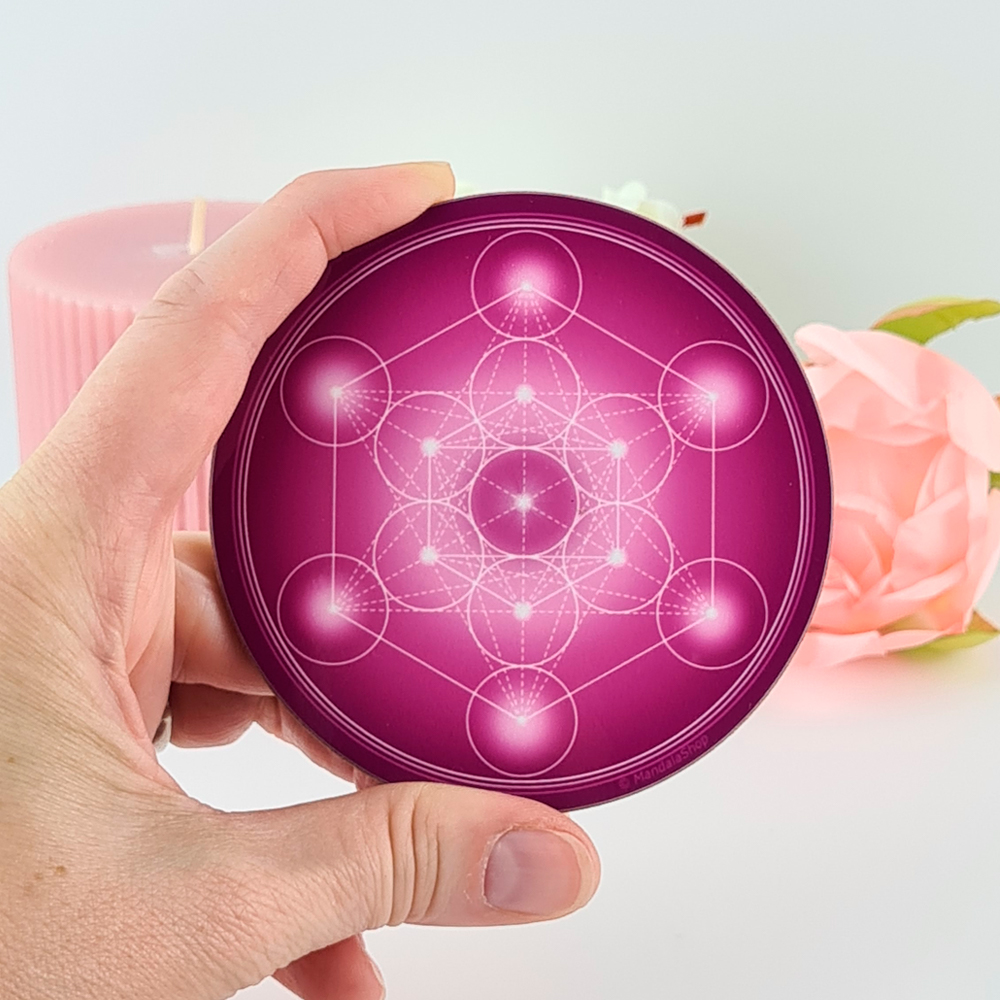
Take a few moments with a Flower of Life, a Metatron's Cube or a Mandala you like. Sit down in a quiet place, away from the hustle and bustle. Sit comfortably, feet firmly planted on the ground, back straight but relaxed. Close your eyes for a few moments and breathe deeply, several times, until you feel yourself coming back to yourself.
Then place your gaze on the center of the Mandala or sacred geometry figure you've chosen. Let the geometry, the rhythm and the stability of the form permeate you. Feel how this shape speaks to you silently, how it naturally refocuses you.
Then, gently, let this inner question emerge:
"What would be right today, in my way of acting, speaking, being present?"
Don't try to answer with your head. Let a feeling, an image, an intuition arise. Answers can be simple, almost invisible: slow down, smile, call someone, finish a task, don't react.
The idea is not to "do something more", but to reconnect to the right momentum, the one that arises from the center and not from stress or fear.
You can repeat this exercise every morning, or whenever you feel scattered, overwhelmed or off-center. It's a simple but powerful ritual for living each day with greater presence, alignment and wisdom.
What about you?
Does it speak to you?
- Have you ever experienced a moment when you knew, without a doubt, what was right?
- Is there a situation in your life today where you're looking for more clarity?
- What's your own way of refocusing when everything's hectic around you?
- Do you have a phrase, gesture or object (like a mandala or a stone) that brings you back to your center?
These little, often invisible, everyday things can be real anchors. And sometimes, it's by sharing them that we discover we're not alone in experiencing them.
I'd be delighted to read your experiences, your questions, or simply a word that has touched you. This space is yours too.
? If you like this content, if this article has inspired or touched you, I invite you to leave a little word in a comment. It supports the blog and nourishes exchanges.
Sources
• Stanford Encyclopedia of Philosophy – “Aristotle’s Ethics”
A leading academic reference that offers an in-depth study of the intellectual virtue of practical wisdom (phronesis) in Aristotle, particularly its role in ethics and the balance of virtues.
• “Phronesis and the Virtues (NE VI 12–13)” in The Cambridge Companion to Aristotle’s Nicomachean Ethics (Cambridge University Press, 2014). A rich and detailed academic chapter exploring how Aristotle connects phronesis to other moral virtues.
• “Phronesis” – article from EBSCO Research Starters
A clear and reliable overview presenting phronesis as practical wisdom, prudence, and good judgment.
• “Discovering clinical Phronesis” (PubMed Central, 2024)
A contemporary application of the concept in the medical field, showing its universal relevance as moral know-how in concrete situations.




 Are we prisoners of our hormones?
 No, not everything is a message from the universe
 Independent businesses sacrificed by the State
 The Octagon: Symbol of Divine Justice and Balance
 13-Moon Calendar: A Return to Nature or a Modern Myth?

Mandalashop - 07/12/2025 12:04:17
Hola Juan Carlos, Muchas gracias por tu mensaje. Me alegra mucho saber que el artículo te ha llegado en el momento justo. Tus palabras me animan a seguir compartiendo desde el corazón. Un abrazo
Juan Carlos - 07/12/2025 12:00:44
Buenos días Veronique Me ha gustado mucho el artículo que has escrito. Como todos los que envias, has puesto sabiduría, sencillez y amor. Este artículo llegó en el momento adecuado.